
AI Recruiting Agents vs ATS: What an AI Hiring Agent Actually Does
An applicant tracking system (ATS) records your hiring: it stores applications and tracks who is at which stage. An AI recruiting agent does the hiring work itself: it turns a brief into criteria, finds candidates, reaches out, screens replies and returns a shortlist with the evidence behind it. The useful question is not "agent or ATS" but which steps you hand to software and which decisions stay with a person.
What is the difference between an ATS, AI features in an ATS and an AI recruiting agent?
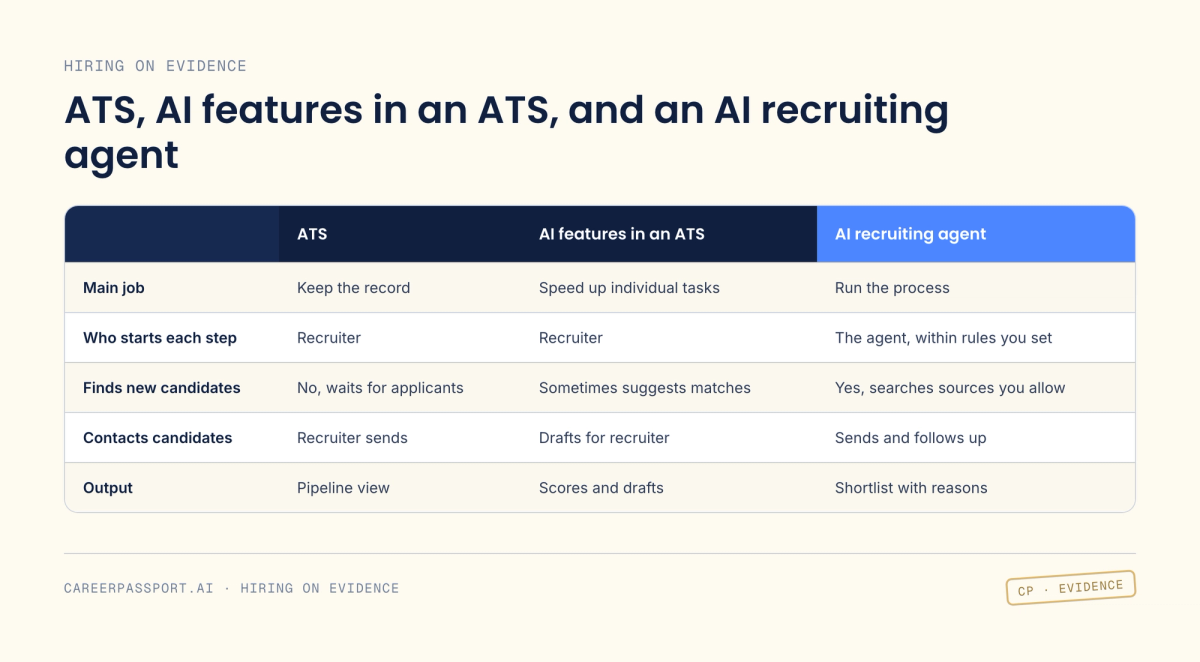
Three kinds of tools get sold as "AI recruiting software". They are not the same thing.
- ATS (applicant tracking system): a system of record. It holds job posts, applications, stages, notes and offer paperwork. It moves only when a recruiter moves it.
- AI features inside an ATS: assistance bolted onto that record. Typical examples are resume parsing, a match score, a drafted job description or a suggested email. A person still triggers each step.
- AI recruiting agent: software that is given a goal ("fill this role") and carries out a sequence of steps on its own, such as sourcing, outreach, follow-ups and first-pass screening, then reports back.
Most teams end up with both: the agent does the work, the ATS keeps the record.
What does an AI hiring agent actually do at each stage?
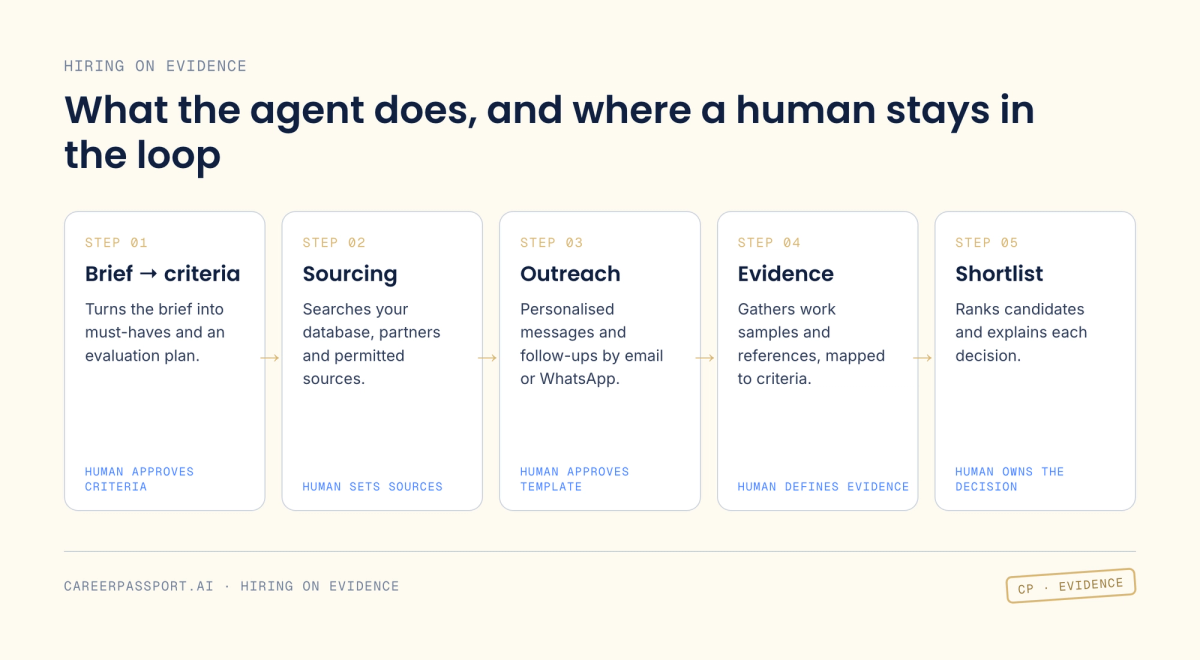
Here is the full run, from brief to interview, and where a human has to stay in the loop.
The pattern: let the agent do volume work (finding, messaging, collecting), and keep people on judgement work (what good looks like, who goes forward).
Can an AI agent reach out over email and WhatsApp and follow up on its own?
Yes, but each channel has rules. On the WhatsApp Business Platform, Meta requires a person's phone number and their opt-in before a business messages them, and the opt-in has to name the business. Once a 24-hour customer service window closes, a business "can only send template messages" to reach the user. In practice an agent can only cold-message a candidate on WhatsApp if that person has already agreed to hear from you.
Email is more flexible, but candidate patience is not. Set a hard cap on follow-ups, stop the moment someone says no, and make sure every message says who is hiring and for what role.
Are autonomous AI recruiters reliable enough to trust with shortlisting?
They are reliable at volume and unreliable at judgement unless you check them. The common failure modes:
- Keyword matching passed off as evaluation. "Kubernetes" on a CV is not evidence that someone has run a cluster in production.
- Confident summaries with nothing behind them. If the agent cannot point to the reply, artifact or reference that supports a claim, the claim is noise.
- Silent false negatives. Strong candidates rejected for a missing keyword never show up in your metrics.
- Bias carried in from past data. If historical hires skew one way, a model trained on them can repeat that skew.
Regulators treat this risk as real. The EU AI Act lists AI systems used "to analyse and filter job applications, and to evaluate candidates" as high-risk in Annex III. Companies using them must "assign human oversight to natural persons who have the necessary competence, training and authority" (Article 26(2)) and keep the system's logs for "at least six months" (Article 26(6)). The Digital Omnibus on AI moved the start date of these obligations for Annex III systems to 2 December 2027.
In New York City, Local Law 144 requires a bias audit of an automated employment decision tool within one year of use, a public summary of the results, and notice to candidates 10 business days before the tool is used. Enforcement began on 5 July 2023.
What does India's DPDP Act mean for AI recruiting?
Candidate data your agent handles is digital personal data under the Digital Personal Data Protection Act, 2023. The parts that matter most for hiring:
- Consent must be "free, specific, informed, unconditional and unambiguous" (Section 6(1)).
- Accuracy: where personal data is likely to be "used to make a decision that affects the Data Principal", the company must ensure its "completeness, accuracy and consistency" (Section 8(3)). An agent that shortlists on stale or scraped data is a compliance problem, not just a quality one.
- Security: failing to take reasonable security safeguards can attract a penalty that "may extend to two hundred and fifty crore rupees" (Schedule).
- Public data: the Act does not apply to personal data a person has made publicly available themselves (Section 3(c)(ii)). A CV or reply a candidate sends you is a different matter.
The DPDP Rules, notified on 14 November 2025, set an 18-month phased compliance timeline, require standalone consent notices, and give companies a maximum of 90 days to respond to requests to access, correct or erase data. Ask any vendor how it handles each of these, and take legal advice for your own setup.
What should I look for when choosing an AI recruiting agent for tech roles?
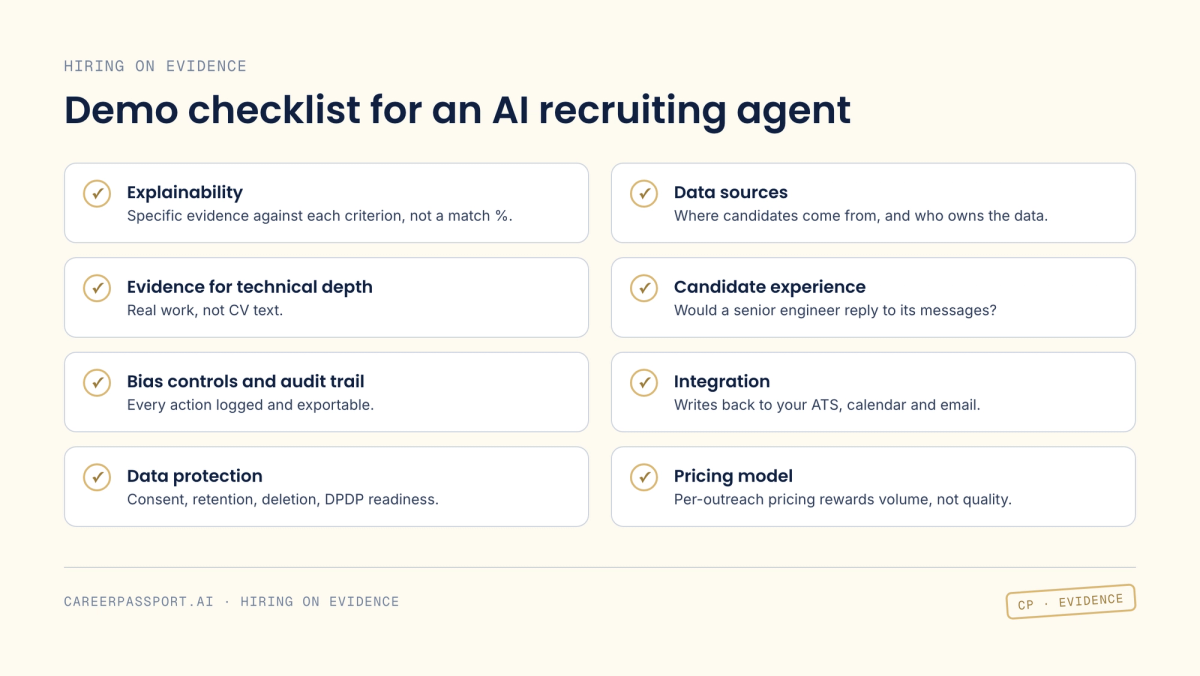
Use this checklist in every demo.
- Explainability of each decision. For any shortlisted or rejected candidate, can it show the specific evidence against each criterion? "92% match" is not an explanation.
- Data sources. Where do candidates come from: your database, partner networks, public profiles? Who owns the data you add?
- Evidence for technical depth. Can it collect and assess real work, such as code, design notes and incident write-ups, rather than CV text?
- Candidate experience. Read the actual messages it sends. Would a senior engineer reply, or block the number?
- Bias controls and audit trail. Can you see every action it took, export logs, and review outcomes by group?
- Integration. Does it write back to your ATS, calendar and email, or create a second pipeline to maintain?
- Data protection. Consent capture, retention, deletion on request, where data is stored, DPDP readiness.
- Pricing model. Per seat, per role, per hire or per outreach. Per-outreach pricing rewards volume, which is the opposite of what you want.
How do you test an AI recruiting agent with a two-week pilot?
- Pick one live role you are already hiring for, ideally one with enough applicants to compare.
- Write the success metrics before day one. Suggested set: time from brief to first shortlist; share of agent-shortlisted candidates the hiring manager agrees to interview; reply rate to outreach; opt-outs and complaints; and how many of the agent's rejections a human reviewer would have advanced.
- Days 1 to 2: hiring manager writes the brief and approves the criteria the agent produces. Approve message templates.
- Days 3 to 9: agent sources, reaches out and screens. Your normal process runs in parallel on the same role.
- Day 10: blind review. A recruiter reviews a random sample of the agent's rejections without seeing its reasons.
- Days 11 to 14: hiring manager interviews top candidates from both tracks and scores them on the same criteria.
- Decide. Compare the two tracks on your metrics. If the agent's shortlist was as good or better and every decision had evidence behind it, expand. If you could not tell why it chose someone, stop.
What are the best AI recruiting tools for a startup hiring its first 20 engineers in India?
For your first 20 engineers, the tool matters less than the discipline. Early hires set your engineering culture and are expensive to get wrong.
- A light ATS is enough for the record. You do not need an enterprise suite at this size.
- Use an agent for sourcing and evidence, not for the final call. Founders or the first engineering lead should interview every finalist.
- Define competencies per role, not just a stack. A first backend hire needs judgement and ownership as much as language skills.
- Ask for proof of work. Repos, design docs and things people shipped tell you more than titles from previous employers.
- Bring in recruitment partners where volume or niche skills demand it, and give them the same criteria the agent uses.
How does CareerPassport's hiring agent work?
CareerPassport is built for evidence-led hiring. The hiring manager writes one brief, and CareerPassport turns it into a structured hiring blueprint: technology requirements, expertise level, and an evaluation matrix drawn from nine competencies (Reasoning, Prioritization, Judgment, Expertise, Execution, Initiative, Communication, Collaboration and Alignment).
An agent then runs the role. It draws candidates from the company's own database, recruitment partners and CareerPassport profiles, approaches them, collects evidence and returns a shortlist that is "cleared to meet". The hiring manager stays in control and can invite, reject or view the evaluation summary for each candidate. In CareerPassport's words: "You step in when there is a decision worth making."
See how it works on the CareerPassport for companies page, or book a free 30-minute demo. Agencies and independent recruiters can read about agentic workflows for recruitment partners.