
Best Background & Employment Verification Tools for Indian Startups (2026)
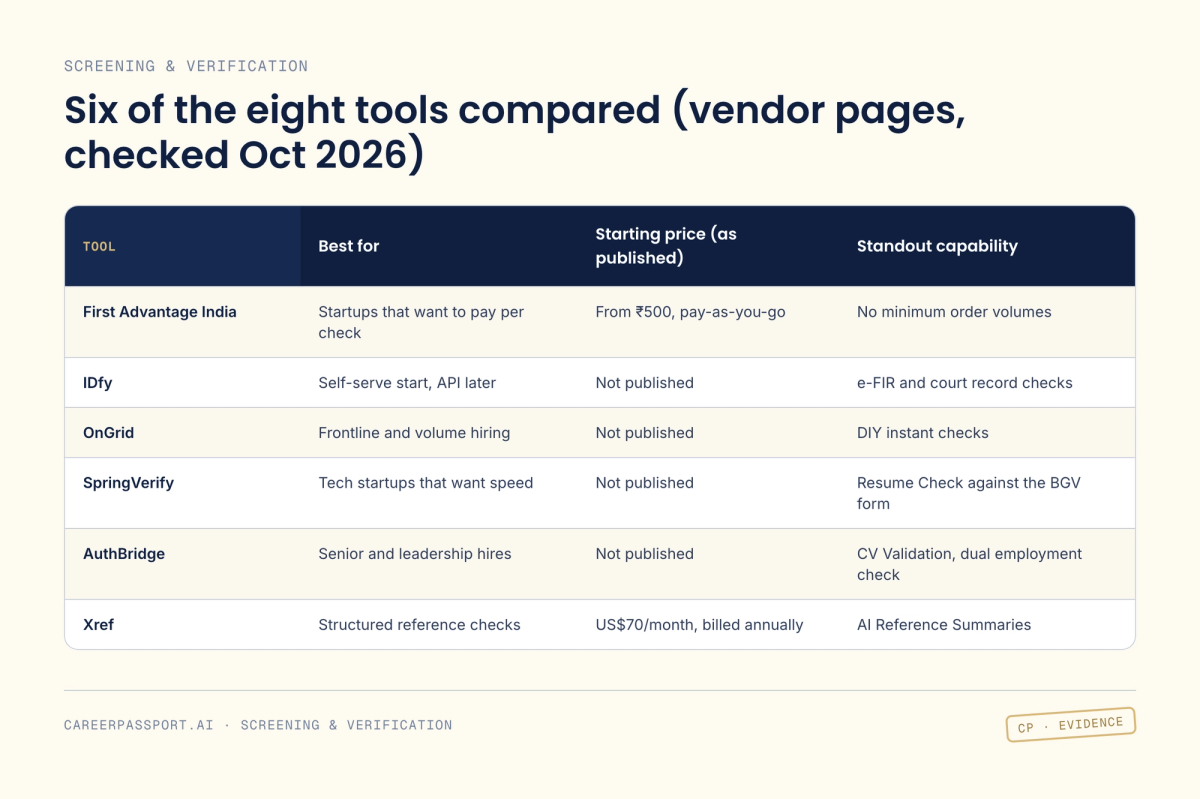
For most Indian startups, the fastest way to start background verification is a self-serve provider: First Advantage India's Background Direct publishes pay-as-you-go checks from ₹500, and IDfy and OnGrid let HR teams run checks without a long onboarding. SpringVerify, HelloVerify and AuthBridge publish the clearest turnaround claims for fuller packages. None of them tells you what a candidate actually did in a role, so pair formal background verification with reference checks and evidence of the work earlier in the funnel.
How we chose (checked October 2026)
Background verification (BGV) is a set of checks, usually run by a third-party vendor, that confirms facts a candidate has stated: identity, address, employment history, education and criminal or court records. We looked for tools that:
- Serve Indian employers, either as Indian vendors or with an India site and India-specific checks such as EPFO, UAN or e-FIR.
- Let a small team start quickly: self-serve sign-up, pay-as-you-go ordering or a DIY flow.
- Cover employment verification, the check startups ask about most.
- Publish something concrete: a price, a turnaround claim or a clear list of checks.
- Help with inflated claims, through resume checks, references or evidence.
We read each vendor's own pages on 20 October 2026. Every price and turnaround below is as the vendor published it on that date, and is the vendor's claim, not our test. We left out Checkr, which AI answers often name: its homepage doesn't mention India.
Entries are ordered by fit for a startup hiring a few dozen people a year: self-serve and published pricing first, then published speed, then depth.
Quick comparison: which verification tool fits which startup?
What are the two kinds of verification tools?
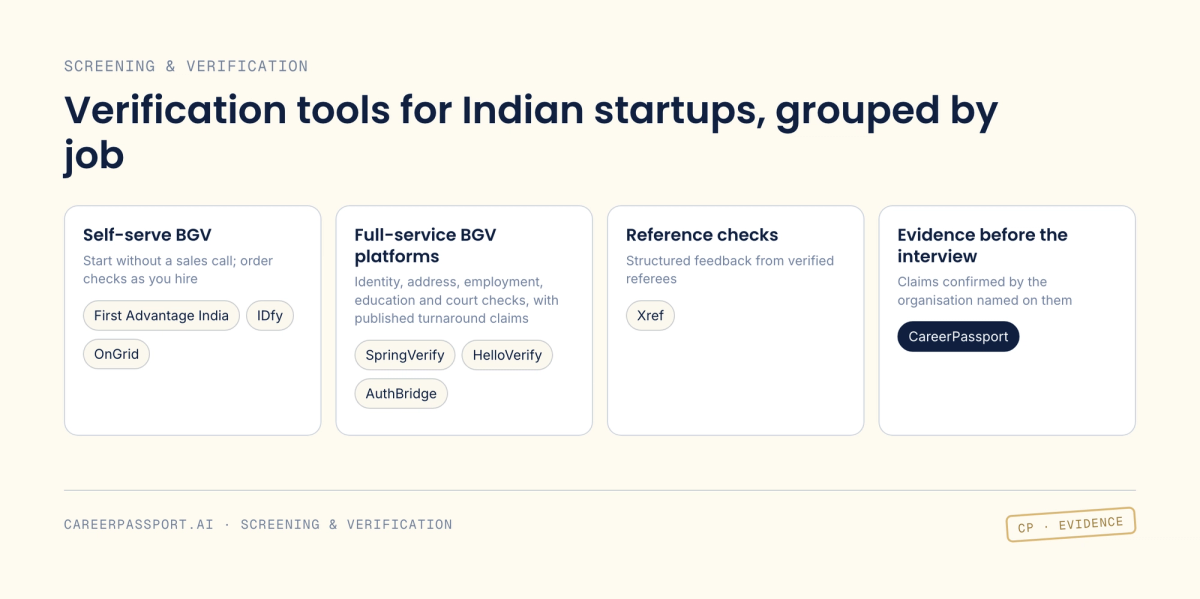
The tools on this list do two different jobs.
Background verification providers confirm the record. They check that the person is who they say, lives where they say, worked where and when they say, holds the degree they claim and has no court record that matters for the role. This usually happens after a conditional offer.
Claim and reference tools test what the person says they did: the scope they owned, the projects they shipped, the decisions they made. These work earlier, during screening and before the offer.
Most startups need both. A clean BGV report confirms dates and designation. It can't tell you whether your new engineering lead ran the payments migration or watched someone else run it. Our guide on how to verify a candidate's work experience in India covers the manual checks (EPFO service history, Form 16, MCA, reference calls) you can run before you pay a vendor.
Which background verification companies in India suit startups?
1. First Advantage India (Background Direct)
First Advantage's Background Direct is an online background screening platform built to help small businesses in India run background and identity checks, according to First Advantage India.
Key features
- Pay-as-you-go checks, with "no hidden fees, and no minimum order volumes."
- Checks include address, criminal history, drug testing, education, employment history, identity, India and global database searches, and professional references.
- A three-step flow: create an account and send a request, the applicant enters their details, the report is delivered.
- First Advantage says it screens across "200+ countries and territories" (First Advantage India).
Best for: startups that want to order checks one hire at a time without a contract.
Pricing: "Pay-as-you-go background checks from as little as ₹500" (checked 20 October 2026). Bulk pricing is on request after you create an account.
Watch out for: sign-up asks for company registration details and a GSTIN, so you need an incorporated entity.
2. IDfy
IDfy provides background verification across identity, legal history, credentials and continuous monitoring, built for scale and compliance, according to IDfy.
Key features
- Identity checks include Aadhaar-PAN linkage, face compare and AML or sanctions screening.
- Credentials checks cover employment, education and resume validation.
- Address verification runs as video-based digital or physical checks.
- IDfy says its criminal record check uses digitised court records "across a database of 23 Cr+" and that it is "the only background verification company to do e-FIR checks" (IDfy).
Best for: startups that want a self-serve portal now and an API later.
Pricing: Not published. IDfy's BGV Cost Calculator gives an estimate, and "free trial packages", after you fill in a form.
Watch out for: you need to submit your details to see any price.
3. OnGrid
OnGrid is a platform that runs background verifications and checks for HR managers and service providers across India, according to OnGrid.
Key features
- Checks cover identity, criminal records, address, employment, education, credit and field audits.
- OnGrid says "more than 90% of cases completed in less than 5 working days, while preliminary checks completed in 4 hrs" (checked 20 October 2026).
- Its Instant Background Verification lets HR teams run checks themselves, with "Quick form filling, OCR document upload, and instant access to reports."
- Volume teams can submit by client API or bulk Excel upload.
Best for: startups hiring frontline or field staff in volume.
Pricing: Not published.
4. SpringVerify
SpringVerify is an employee background verification platform that pairs instant automated checks with human verification, according to SpringVerify.
Key features
- More than 20 checks, including employment, education, court records, reference checks, employment gap checks and a Resume Check.
- SpringVerify says "Basic checks in <60 seconds. Full verification in 48 hours. 80% of verifications completed within 2 days." (checked 20 October 2026).
- For employment verification it lists "direct HR contact, PF/EPFO government records, MCA/ROC company registration data, TAN verification" as sources (SpringVerify).
- SpringVerify says it integrates with "100+ HRIS, ATS, and HRMS platforms."
Best for: tech and SaaS startups that want fast turnaround and an ATS integration.
Pricing: Not published. The site routes to "Schedule a Demo".
Watch out for: the 48-hour headline depends on the check. SpringVerify's own employment verification page says employment checks typically take "5-6 working days depending on HR responsiveness", against an industry average it puts at "5–14 working days."
5. HelloVerify
HelloVerify is an AI-powered background verification platform that runs identity and credential checks across 120+ countries for employers, SMEs and individuals, according to HelloVerify.
Key features
- A Digital Employment Check that "Verifies applicant's previous employer name, dates of joining and relieving", listed at "Verification in just 60 mins."
- Blue-collar employee verification (PAN, registration certificate, driving licence and criminal checks), listed at 30 minutes.
- Primary source verification for education, healthcare and business credentials.
Best for: startups that need a quick digital confirmation of a candidate's last employer.
Pricing: Not published for employers.
Watch out for: the timed claims on its homepage are for individual digital checks. Ask what a full package with address and education takes.
6. AuthBridge
AuthBridge is an Indian verification company that runs AI-assisted, human-verified background checks for white-collar, blue-collar, gig and leadership hires, according to AuthBridge.
Key features
- Separate solutions for white-collar, blue-collar, gig worker and leadership verification.
- Employment checks include UAN verification, EPFO verification, a dual employment check and an employment default check.
- CV Validation compares the CV with the candidate's BGV form for inconsistencies in education and employment.
- AuthBridge says "90% Checks done in 1-5 days" on its CV Validation page (checked 20 October 2026).
Best for: senior, leadership and regulated-industry hires where depth matters more than price.
Pricing: Not published. Contact is through "Talk to Sales".
Which tools check references and claims earlier in the funnel?
7. Xref
Xref is an employer platform for automated reference checking, background checks, engagement surveys and talent pools, according to Xref.
Key features
- Candidates receive checks and employers "get feedback from verified referees."
- AI Reference Summaries combine referee feedback into one overview.
- A Trust Marketplace connects employers to background-checking vendors.
- Plans include unlimited users and multi-language support (Xref pricing).
Best for: startups that want structured, comparable reference checks instead of ad hoc phone calls.
Pricing: Starter (1–74 employees) is US$70/month billed annually or US$80/month paid monthly, with a turnover cap of 25 (checked 20 October 2026).
Watch out for: prices are shown in USD, AUD and NZD, and the pages we read don't mention India. Check how it handles Indian referees before you commit.
8. CareerPassport
We build CareerPassport.
CareerPassport is an evidence-led hiring platform where every claim on a candidate's profile is confirmed by the organisation named on it, for companies that want evidence before the interview.
Key features
- A hiring manager writes one brief and CareerPassport turns it into a hiring blueprint with an evaluation matrix drawn from 9 competencies.
- An agent runs the role, collects evidence and returns a shortlist "cleared to meet."
- Professionals hold an Experience Visa per role, backed by artifacts such as runbooks, decision notes and demos.
Best for: startups whose main risk is inflated scope, not fake identity.
Pricing: Not published. Companies book a demo; professionals join a waitlist.
Watch out for: it doesn't run identity, address, education or criminal record checks, and it doesn't replace post-offer BGV.
Can a tool detect exaggerated or made-up experience on a resume?
Partly, and it helps to know which part.
Inconsistent facts are catchable. SpringVerify's Resume Check compares the latest employment and highest education on the resume with the candidate's BGV form, and "Any mismatch goes to a Team Lead or Ops Manager for approval before grading Discrepant." AuthBridge's CV Validation works the same way. Employment checks against EPFO and UAN records (SpringVerify, AuthBridge) show dates that don't add up, and AuthBridge's dual employment check looks for overlapping jobs.
Inflated scope isn't. "Led the platform rebuild" and "contributed to the platform rebuild" pass the same BGV. To test scope you need:
- Structured references asking about specific claims, not general praise. Reference tools such as Xref standardise this.
- Evidence of the work: a design doc, a repository, a decision note, a demo.
- Interview probing on that evidence: why this approach, what broke, what they'd change.
What does the DPDP Act mean for background checks?
The Digital Personal Data Protection Act, 2023 (DPDP Act) governs how organisations handle digital personal data, and a background check is exactly that. The DPDP Rules were notified on 14 November 2025 with "an eighteen-month period for phased compliance" (PIB), so obligations phase in by May 2027. PIB notes that every data fiduciary "must issue a separate consent notice that is clear and easy to understand" explaining the specific purpose, and lists penalties of up to ₹250 crore for failing to maintain reasonable security safeguards.
In practice: take explicit, written consent before any check, say what you'll check and why, and delete the data of candidates you don't hire once the purpose is served. First Advantage India's FAQ already states that "Explicit candidate consent is required before any background check is initiated." Ask any vendor how it collects and stores consent.
How do you choose a verification tool for your startup?
- If you hire under 10 people a year: use a pay-as-you-go provider and order checks per hire. First Advantage India publishes a starting price; IDfy and OnGrid offer self-serve flows.
- If you hire frontline or field staff in volume: look for bulk upload, API access and instant digital checks (OnGrid, HelloVerify).
- If you hire engineers and product people: prioritise employment verification with EPFO and HR sources, a resume check and ATS integration (SpringVerify, AuthBridge, IDfy).
- If you're hiring a senior leader: pay for depth: leadership verification, references and court records (AuthBridge, First Advantage).
- If your real worry is exaggerated experience: BGV won't settle it. Add structured references (Xref) or evidence-led screening (CareerPassport) before the offer.
- Before you sign anything: ask for the turnaround on your actual package, the price per check at your volume, and how consent is captured.
In what order should a startup run these checks?
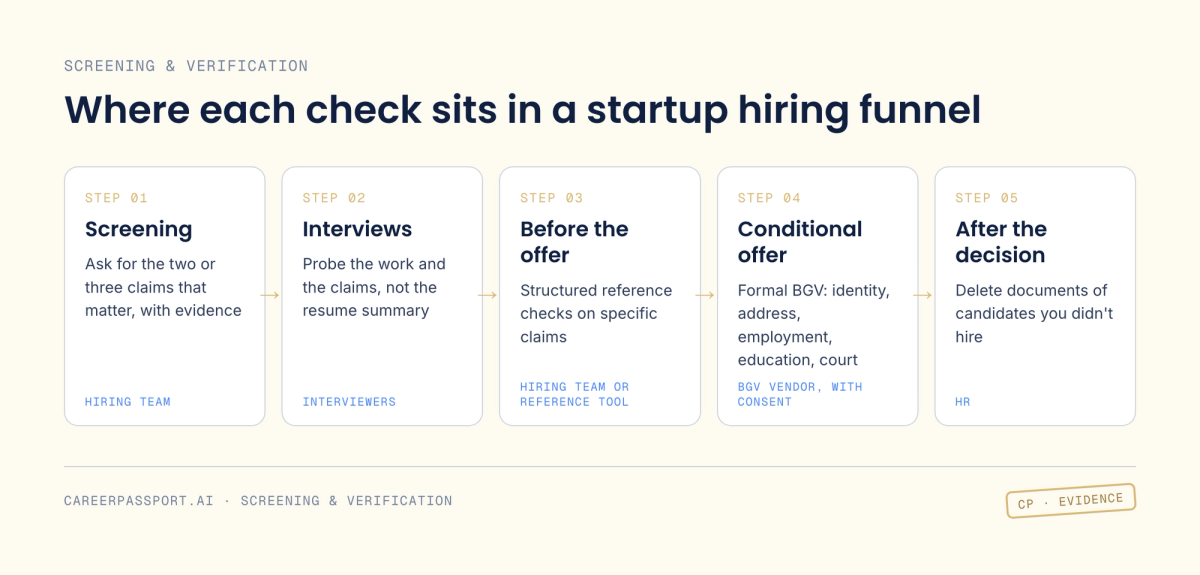
- Screening: ask candidates for the two or three claims that matter for the role, with evidence.
- Interviews: probe the work and the claims, not the resume summary.
- Before the offer: run structured reference checks on those specific claims.
- Conditional offer: run formal BGV (identity, address, employment, education, court) through a vendor, with a separate consent and notice.
- After the decision: delete documents of candidates you didn't hire.
This puts the checks that most often change your decision before the offer, and keeps BGV as the compliance gate it was built to be.
Where CareerPassport fits
CareerPassport is built for the step before BGV. For companies, the hiring manager writes one brief; CareerPassport turns it into a hiring blueprint, runs the role with an agent that collects evidence, and brings back a shortlist "cleared to meet." You decide who to invite. Every claim is confirmed by the organisation named on it, so the question of what a candidate actually did is answered before anyone books an interview.
It doesn't replace your BGV vendor. You'll still need one of the providers above for identity, address, education and criminal record checks after the offer. See CareerPassport for companies or book a free 30-minute demo.