
What Is Split-Fee Recruitment? A Guide for Indian Recruitment Agencies
Split-fee recruitment is when two recruitment agencies fill one vacancy together and share the placement fee. One agency, the role owner, holds the client and the mandate; the other, the candidate owner, supplies the person who gets hired. The most common split is 50/50, and it only works smoothly when ownership, fee, split and payment terms are written down before a single CV changes hands.
What is split-fee recruitment?
Split-fee.com defines it as two agencies filling one vacancy together and sharing the fee, and describes it as "a way of working a role, not a way of pricing one." The client pays the same fee it would pay a single agency. What changes is who does the work and who gets paid.
There are always two sides:
- Role owner (also called the job-side, vacancy-side or job order firm). It has the client relationship and the open mandate but no ideal candidate in its own pipeline.
- Candidate owner (the candidate-side firm). It has the right candidate but no matching role of its own.
NPAworldwide adds a useful rule: each partner keeps a direct relationship with the party it represents. The role owner talks to the client; the candidate owner talks to the candidate. That separation is what stops a split turning into a land grab.
How does a split placement work, step by step?
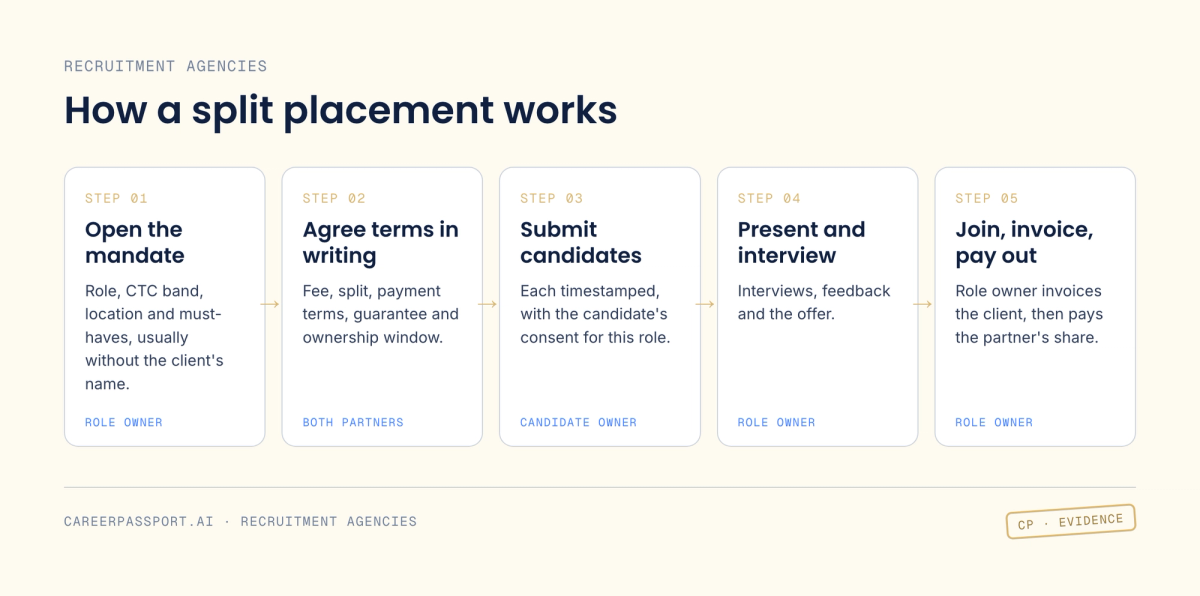
- The role owner opens the mandate to one partner or a network, sharing enough detail (role, CTC band, location, must-have skills) to find candidates, but usually not the client's name.
- Both sides agree the commercial terms in writing: fee, split, payment terms, guarantee and ownership window.
- The candidate owner submits candidates, each with a timestamp, after the candidate has agreed to be put forward for this role.
- The role owner presents candidates to the client and runs interviews, feedback and the offer.
- The candidate joins. The role owner invoices the client.
- The client pays and the role owner pays out the candidate owner's share on the agreed terms.
What does a split placement look like in rupees?
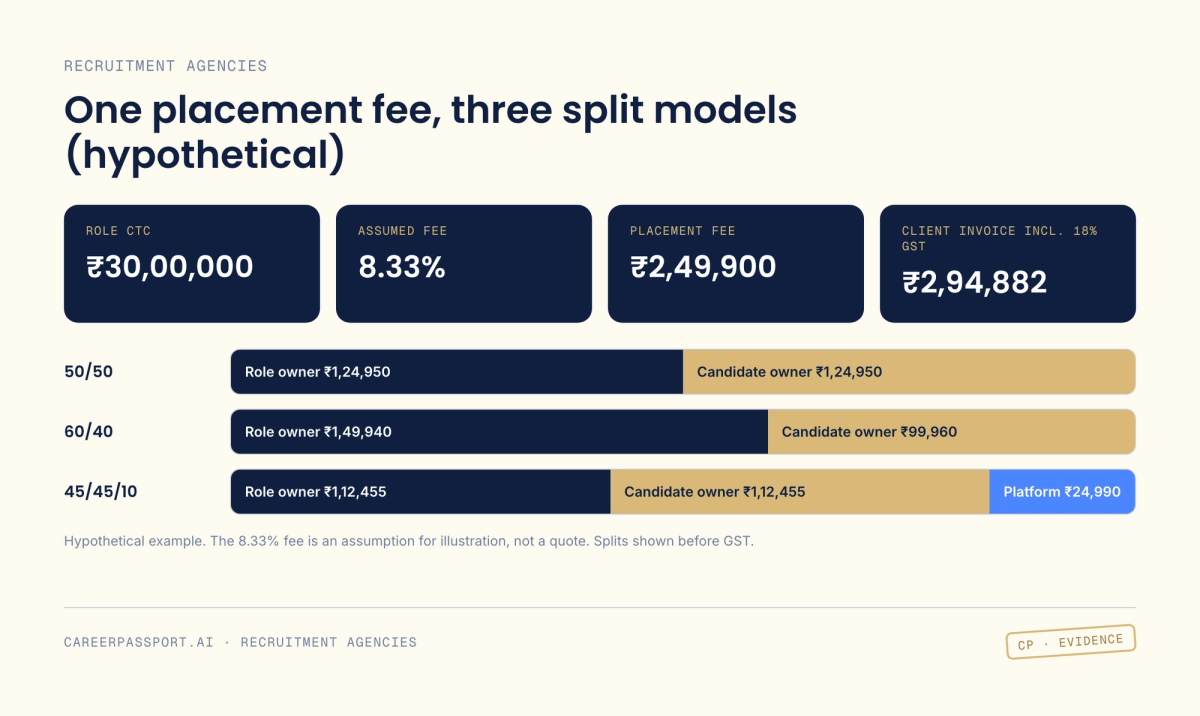
Here is a hypothetical example. The 8.33% fee is an assumption for illustration, not a quote. Wisemonk reports that permanent placement in India typically runs "8.33% to 16.67% of annual CTC (roughly one to two months of salary)", and that "agency fees attract 18% GST on top of the quoted rate."
- Role: senior backend engineer, Bengaluru, ₹30 LPA (₹30,00,000 annual CTC)
- Assumed fee: 8.33% of CTC
- Placement fee: ₹30,00,000 × 8.33% = ₹2,49,900
- GST at 18%: ₹44,982, so the client invoice is ₹2,94,882
How that ₹2,49,900 is shared depends on the split model:
GST is charged on the client invoice and is not part of either partner's earnings. Ask your CA how GST applies to the invoice the candidate owner raises on the role owner.
What's a fair fee split between recruitment partners?
There is no law that sets it. These are the patterns the sources actually describe:
- 50/50. NPAworldwide calls it "the most common arrangement, but certainly not the only option," and its split placement guidelines say that "in the absence of an agreement, fees will be shared on a 50/50 basis."
- 60/40. Top Echelon describes it as a split "where one recruiter receives a larger share based on their contribution." Split-fee.com gives managing interviews as an example of that extra effort.
- Network cut. Split-fee.com cites 45/45/10, where the platform keeps 10%. NPAworldwide's FAQ describes 47.5% to each trading partner, with "2.5% from each trading partner" going to the network.
- Candidate-heavy splits. RecXchange lists "Typical split: 50/50" for shared roles and "Up to 70% in your favour" on employer roles where no second recruiter sits on the client side.
A fair split reflects who carries the risk and the work. If the role owner writes the brief, manages a demanding client, runs five interview rounds and negotiates the offer, 60/40 in its favour is reasonable. If the candidate owner found a rare profile the role owner could not, 50/50 is the floor.
What should a split-fee agreement cover?
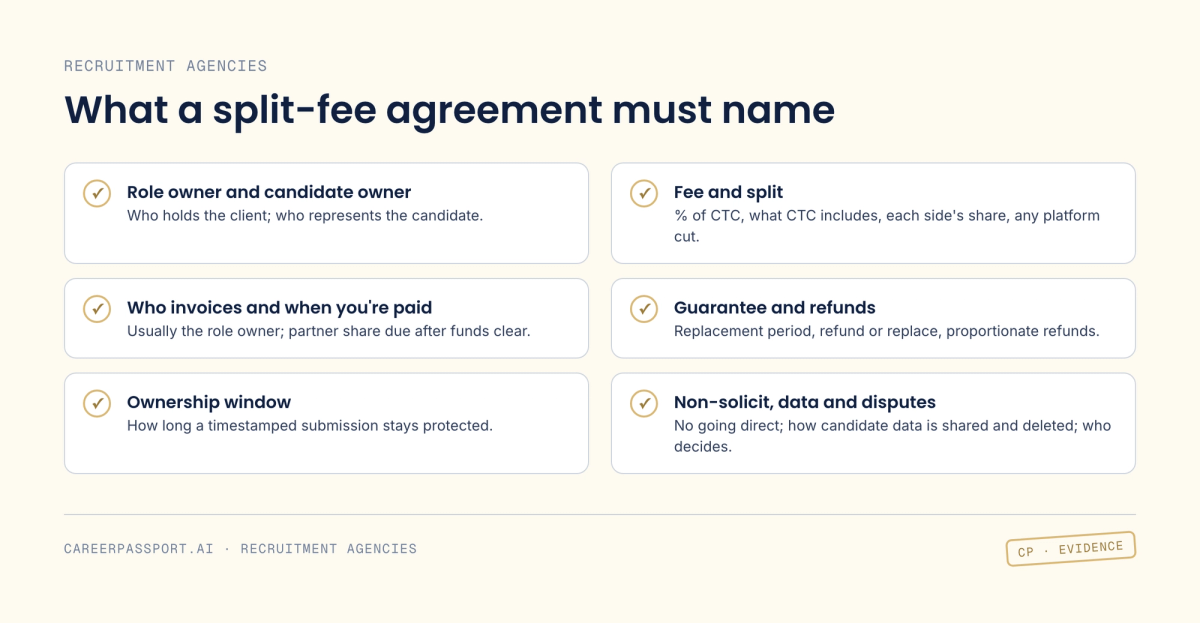
Top Echelon's advice is to "formalize your agreements in writing." For an Indian split, the agreement should name:
- Role owner: which firm holds the client and the mandate
- Candidate owner: which firm represents the candidate
- Fee: the percentage of CTC, and whether CTC includes variable pay and joining bonus
- Split: each side's percentage, and any platform cut
- Who invoices: normally the role owner, who bills the client
- Payment terms: when the partner's share is due after the client pays (for example, within a set number of days of funds clearing)
- Replacement or guarantee period: Wisemonk reports Indian agencies typically offer 30 to 90 days. Agree whether a fall-off means a refund or a replacement, and who finds the replacement
- Refund mechanics: NPAworldwide's guidelines ask each firm to return its proportionate share of a refund "within five (5) calendar days after notification of liability"
- Candidate ownership window: how long a submission stays protected. NPAworldwide treats referrals as "valid for one year"
- Non-solicit: neither side approaches the other's client or candidate directly, during and after the deal
- Confidentiality and data: what candidate data may be shared and how it is deleted
- Disputes: who decides, and how quickly
What goes wrong in split placements, and how do you prevent it?
How can a solo headhunter or boutique agency grow with splits?
A solo recruiter's ceiling is their own bandwidth and network. Splits raise it in two directions.
- Take mandates you could not fill alone. A boutique strong in fintech gets a request for a Kubernetes platform lead. Rather than declining or wasting weeks, it opens the role to a partner who places DevOps talent every month.
- Earn from candidates you cannot place. Strong candidates who do not fit your current roles are idle inventory. Submitting them to a partner's mandate earns a share instead of nothing.
- Win clients beyond your niche. You can say yes to a client's full hiring plan and route the roles outside your depth to trusted partners.
- Keep your database yours. You share one candidate for one role, not your whole list.
How do you find and vet reliable recruitment partners for niche tech roles in India?
Start with recruiters you already know from past mandates, then look at split networks and marketplaces. Before the first split, check:
- Niche depth: recent placements in this exact skill set and seniority band
- References: at least one firm they have split with before
- Payment record: how fast they paid partners in past splits
- Candidate quality: do they screen properly, or forward keyword matches?
- Consent practice: do they confirm interest before submitting?
- Paperwork: will they sign a written agreement before sharing anything?
- Communication: Top Echelon recommends "regular check-ins and updates." Test it on a small first deal.
What software manages split placements?
Dedicated split networks and marketplaces handle matching and terms, and some, like NPAworldwide, publish their splits. Whatever you use, a spreadsheet and WhatsApp included, check that it gives you:
- A written agreement attached to each mandate, locked before candidate details are shared
- Timestamped submissions per candidate per role
- A shared status for each placement through to payout
- Control over which mandates you open to partners
- A private candidate database that partners cannot browse
How does CareerPassport handle split placements?
CareerPassport is built for recruitment partners, solopreneurs, headhunters and agencies, and puts the commercial details of a split inside the workflow. A collaboration agreement records the role owner, candidate owner, fee, partner split and payment terms, and each placement moves through Submitted → Interviewed → Joined → Invoice raised → Payout due, so both sides see the same status.
You choose what to share. You can run your own mandates privately, work on roles posted by companies and partners, or open selected mandates to CareerPassport's curated network and decide the split. Your scattered candidate data (ATS, Excel, email, WhatsApp, notes, files) becomes private talent intelligence you can search in plain language, and your personal candidate database always stays private.
See how it works on the CareerPassport page for recruitment partners, or book a free 30-minute demo.