
What Is Evidence-Based Hiring? A Practical Guide for Hiring Managers
Evidence-based hiring is a way of selecting people where every decision traces back to job-relevant proof: real work the candidate has already produced, claims confirmed by the organisation named on them, and scores against criteria written before screening began. It replaces "this resume looks strong" and "I liked them" with a shared standard that every interviewer applies to every candidate. Done well, it is faster for experienced hires than stacking take-homes and interview rounds, because you start from work that already exists.
What is evidence-based hiring, exactly?
It has three parts, and you need all three:
- A written standard. Before anyone screens a CV, the hiring manager turns the brief into a small set of competencies (the capabilities the job actually needs), each with a weight and a description of what strong, adequate and weak look like. This is the evaluation matrix.
- Evidence per competency. Every score must point to something concrete: an artifact, a verified claim, or a specific answer in a structured interview.
- Consistent scoring. Every candidate is scored on the same criteria, by interviewers who rate independently before they discuss.
Remove any one part and you are back to impressions. A matrix with no evidence is a form. Evidence with no matrix is a pile of links.
How is it different from resume screening, skills tests and take-homes?
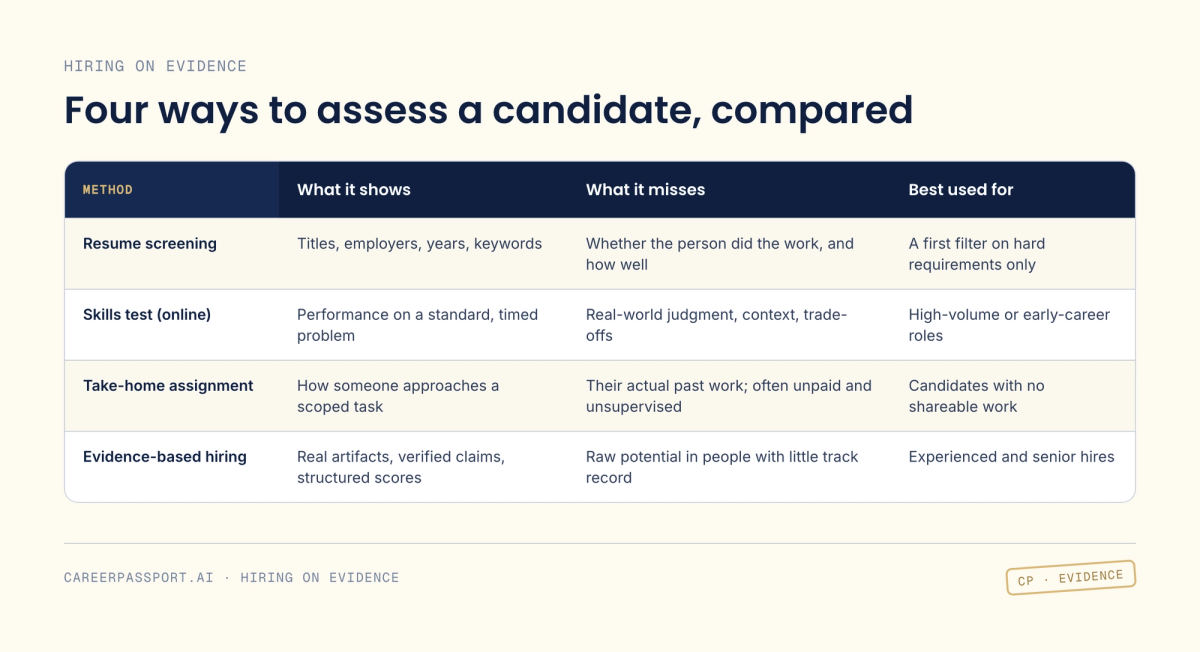
The key difference: the other methods each produce one signal. Evidence-based hiring is the frame that decides which signals count, how much, and for which competency.
What counts as evidence?
Work artifacts. Things the candidate made in real work: code and pull requests, design docs, decision notes, runbooks, incident write-ups, load-test results, demos, dashboards, campaign briefs. An artifact shows the quality of thinking under real constraints, which a puzzle cannot.
Verified claims. "Led the migration to Kafka" or "cut settlement failures by a third" is a claim until someone who was there confirms it. Verification means checking with the organisation or person named on the claim, not with a reference the candidate hand-picked to say nice things.
Structured competency scores. Answers to the same pre-planned questions, rated against written anchors. The U.S. Office of Personnel Management describes structured interviews as asking every applicant the same set of pre-defined lead and probe questions, scored against proficiency benchmarks (OPM). Behavioural questions ask about past experience; situational questions ask what someone would do in a job-like scenario.
What does the research say?
The classic reference is Schmidt and Hunter's 1998 meta-analysis of 85 years of selection research. It reported operational validity (the correlation between a method's scores and later job performance, after statistical corrections) of .54 for work sample tests, .51 for structured interviews and .38 for unstructured interviews. Resume-style proxies were weak: .18 for years of job experience and .10 for years of education (Schmidt & Hunter, 1998).
Those headline figures have since been revised. Sackett, Zhang, Berry and Lievens (2022) showed that the range-restriction corrections used in earlier meta-analyses were often inappropriate and overstated validity. Their revised estimates, as summarised by the same authors in 2023 (Sackett et al., 2023):
- Structured interviews: .42 (was .51), now the highest mean validity on their list
- Job knowledge tests: .40 (was .48)
- Work sample tests: .33 (was .54)
- Cognitive ability tests: .31 (was .51); the 2023 table adds a later estimate of .23
- Unstructured interviews: .19 (was .38)
- Years of job experience: .07 (was .18)
Two caveats matter for practice. First, the spread is wide: the authors give structured interviews an 80% credibility interval of .18 to .66, so how you design the interview matters as much as the label. Second, they note that work samples and job knowledge tests mainly suit applicants with prior experience or training. Education is not in the 2023 summary table, so treat the 1998 figure for it as the older estimate.
The practical reading: structure and job relevance beat impressions, and no single method is enough on its own.
How do you turn a job brief into an evaluation matrix?
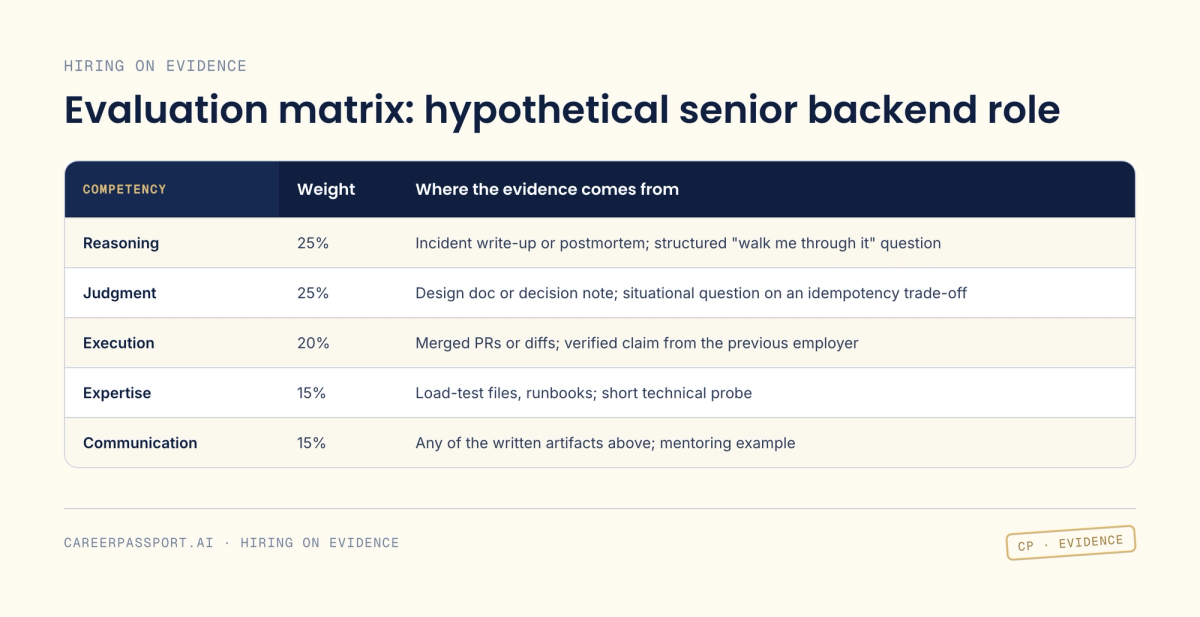
Here is a hypothetical example. A 60-person Bengaluru fintech is hiring a senior backend engineer (budget ₹40–55 LPA). The brief: own the UPI settlement and reconciliation service, cut time spent investigating failed settlements, mentor two mid-level engineers. Stack: Go, Postgres, Kafka.
Step one is to pick the few competencies that decide success in this role, not all of them. Step two is to weight them and write what a top score looks like.
Score each competency 1 to 4, with anchors for 1 and 3 written as well. Every score needs a one-line evidence note. Multiply by the weights for a total, but read the profile too: a 2 on Judgment for a senior hire should be a conversation, whatever the total says.
That is the whole move: brief in, matrix out. You can do it in a spreadsheet in an hour. Tools can automate the first draft, but a human should approve the weights.
Are take-home assignments still worth it?
Sometimes. For an experienced candidate with real artifacts, a weekend take-home mostly measures how much free time they have. Reviewing existing work plus a 45-minute walkthrough ("why this schema? what broke? what would you change?") tests the same competencies and shows whether the person actually understood what they built. The walkthrough also helps when you cannot tell how much of a submission was written with an AI assistant.
Keep take-homes for candidates with no shareable work (freshers, people whose work sits under NDA), cap them at two or three hours, and score them on the same matrix.
How should a startup roll this out?
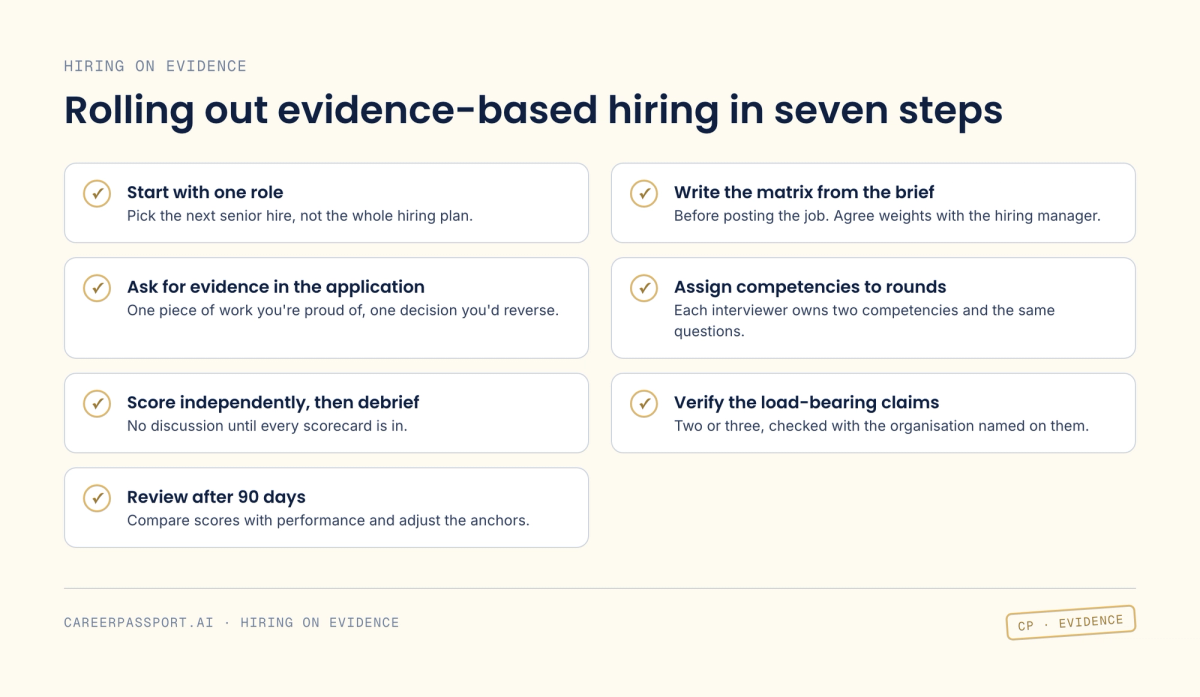
- Start with one role. Pick the next senior hire, not the whole hiring plan.
- Write the matrix from the brief before posting the job. Get the hiring manager and one interviewer to agree weights.
- Ask for evidence in the application. "Share one piece of work you are proud of and one decision you would reverse" gets more signal than a cover letter.
- Assign competencies to rounds. Each interviewer owns two competencies and prepares the same questions for every candidate.
- Score independently, then debrief. No discussion until every scorecard is submitted with evidence notes.
- Verify the claims that drive the decision. Two or three load-bearing claims, checked with the organisation named on them.
- Review after 90 days. Compare matrix scores with how the hire is doing and adjust anchors for the next role.
When is evidence-based hiring overkill, or where does it fail?
- High-volume, entry-level hiring. If a role pulls thousands of Naukri applications, you cannot review artifacts for each. Sackett and colleagues note that structured interviews are not readily suited to high-volume screening; a short standard test plus a structured final round is more realistic.
- Freshers and career switchers. Little to show and little to verify. Score potential with situational questions instead.
- Confidential work. Much of the best work in banking, defence or client services cannot be shared. Accept redacted decision notes or verified claims instead of the artifact itself.
- Portfolio bias. People with caregiving duties or demanding jobs may have fewer side projects. Count work-from-work, not just GitHub stars.
- Matrix theatre. A scorecard filled in after the debrief, to justify a decision already made, is worse than no scorecard.
- Data obligations. Artifacts and verification records are personal data. Under India's DPDP Rules, notified on 14 November 2025, a consent notice must explain the specific purpose for which personal data is collected and used (PIB). Tell candidates what you collect and why.
Which tools support evidence-based hiring?
Most stacks combine categories. Cutshort's 2026 map of 54 hiring tools in India groups them into sourcing, screening, assessments (for example HackerRank, Codility and TestGorilla), interviewing, ATS and background verification (for example AuthBridge, SpringVerify and IDfy) (Cutshort). Assessments give you standard test scores, ATS scorecards give you structure, and verification firms check candidate backgrounds. The gap many teams feel is the part in between: turning a brief into criteria, gathering real work, and confirming the claims that matter for one role.
How does CareerPassport do evidence-based hiring?
CareerPassport is built around this method. The hiring manager writes one brief. CareerPassport turns it into a hiring blueprint: technology requirements, expertise level, and an evaluation matrix chosen from nine competencies (Reasoning, Prioritization, Judgment, Expertise, Execution, Initiative, Communication, Collaboration, Alignment).
An agent then runs the role. It draws candidates from the company's own database, recruitment partners and CareerPassport profiles, approaches them, collects evidence, and returns a shortlist that is cleared to meet. The hiring manager stays in control: invite, reject, or view the evaluation summary. Every claim is confirmed by the organisation named on it.
Candidates' CareerPassports hold artifacts as evidence (runbooks, decision notes, patches, load-test files, demos), so the review step starts from work that already exists. Recruitment partners can run the same evidence-led process on their own mandates through CareerPassport for recruitment partners.
If you want to see a matrix built from one of your own briefs, book a free 30-minute demo.